Wednesday, April 20, 2011

Jackie's Hall of Fame Character

"After the game, Jackie Robinson came into our clubhouse and shook my hand. He said, 'You're a helluva ballplayer and you've got a great future.' I thought that was a classy gesture, one I wasn't then capable of making. I was a bad loser. What meant even more was what Jackie told the press, '(Mickey) Mantle beat us. He was the difference between the two teams. They didn't miss (Joe) DiMaggio.' I have to admit, I became a Jackie Robinson fan on the spot. And when I think of that world Series, his gesture is what comes to mind. Here was a player who had without doubt suffered more abuse and more taunts and more hatred than any player in the history of the game. And he had made a special effort to compliment and encourage a young white kid from Oklahoma." (Mantle, n.d.)

Mickey Mantle, the voice behind the quote above and my personal favorite player, is a Hall of Fame center fielder that played his first rookie season in 1952. This is important because he was from the southern state of Oklahoma which is notorious for its racist behavior and he began his career after Robinson but before he had really established himself as a Hall of Fame worthy athlete. I think the impact that this occurance had on Mickey Mantle, a white southern athlete, shows just what kind of character and influence Jackie had not only on other black athletes and young kids but also on his peers that at one point in their lives probably had some sort of prejudice enstilled in them. It shows that Robinson had a class act and the kind of character that others can easily look up to and try to emulate.

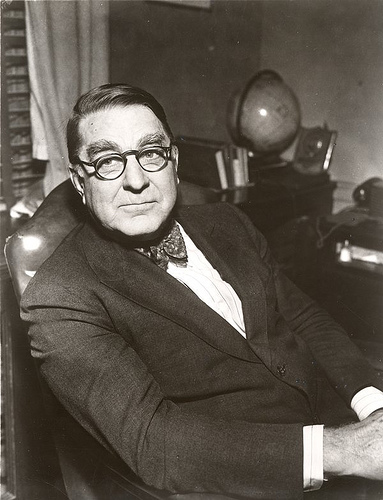
Thank you Mr. Rickey


When people think of the end of segregation in baseball most people first think of Jackie Robinson, and rightly so, but there was another man whom without baseball might not have been integrated. That man is Branch Rickey, founder of the farm system which all professional baseball teams in America use today and the spearhead behind Jackie Robinson's debut into Major League Baseball. Rickey himself although he was the owner of the Dodgers at the time went out to find the perfect athlete to begin integration and did not stop until he found him. Not only was this a big move on the side of equality which Rickey was a die-hard fan of, it was a great business decision because now Rickey and the Dodgers owned a monopoly of sorts on the revenue that black fans would contribute to see another black athlete play. Mr. Rickey was a very smart man from the business side of things and from a humanitarian standpoint he showed the epitome of reciprocity.
Below is a commemorative plaque of Mr. Rickey for his contribution to the game of baseball and above is a photograph of what he looked like (not what I expected upon first seeing him after knowing what he did).

Some opposition

In Where Have We Gone, Mr. Robinson Gerald Early tries to prove that Jackie Robinson was not as successful in ending segregation as most people would like to think. He tries to do this by questioning just how integrated sports really are stating "So what would Robinson make of the relationship between the game he loved and African Americans today? He would find reasons to be encouraged: baseball is more diversified and more international than ever, racism is considerably lessened, and there are nearly twice as many teams as when Robinson first broke in 60 years ago. But African Americans are disappearing from baseball. Blacks make up 8% of major league baseball players today and only 3% of players on NCAA Division I baseball teams." (Early, 2007) but he forgets to add that the NCAA is not the only place where professional athletes get recruted and that in the 70's and 80's there were nearly 10 times as many blacks in professional baseball as today. This may be because talent in the black community is going down or they are less interested but nonetheless this has nothing to do with Robinson because without him these numbers could still be at 0.

Source:
Early, G. (2007). Where have we gone, Mr. Robinson?. time, 169(17), 48-49.

Jackie Robinson Day

In honor of Jackie Robinson day which was celebrated this last friday (4/15) ALL players in Major League Baseball wore Jackie's jersey number 42 as a sign of respect and gratitude for what he went through. This is significant because ordinarily nobody in all of professional baseball is allowed to wear that number because it was officially retired; something that has never been done for any other player in history. That is how momentous Mr. Robinson was to the game and in the video below some big name professional baseball players show their gratitude to be able to wear his number.

http://www.youtube.com/watch?v=L2bmQ9m-3QQ

An image to go with the name

http://www.youtube.com/watch?v=4Pf1RVuQaDM

This link above will take you to a video of Jackie Robinson. The video gives a short background of what kind of player and person he was plus it shows a short clip of him stealing home which is something that doesn't happen often, showing how great of a player he really was.


Wednesday, April 13, 2011

Food For Thought

In this journal article the author, Steve Sailer, touches on the idea of collusion. He states that baseball teams colluded to not blacks play alongside with white just how colleges collude for whites and asian students. I'm not entirely sure if I agree with this but this is what Sailer says, "The team owners' ill-named ``gentlemen's agreement'' to discriminate against blacks closely resembles today's unspoken understanding among the presidents of another government-sanctioned cartel, our elite colleges, that they will all discriminate against whites and Asians. Both clubowners and college presidents chose to head off ugly incidents by pre-emptively caving in to racial activists. They then browbeat all their peers into closing ranks, lest a lone dissident spotlight their spinelessness." (Sailer, 1996)
Agree or disagree if you will but it is definitely something to think about from my point of view.

Source:
Sailer, S. (1996). How Jackie Robinson desegregated America. National Review, 48(6), 38-41.
 

Hammerin' Hank's role model

Here is an excerpt of a journal entry that I found interesting because it is about one baseball legend's encounter with another baseball legend that convinced him to pursue a career as a professional athlete.

"We had seen the Negro Leagues play, but this was history in the making. Everything that Jackie did was put up here. He'd take infield practice and batting practice, and he'd put on a show. I didn't see the game that day, but I skipped shop class to hear him speak in a little community place on Davis Avenue. Jackie was a hero and an icon, somebody you looked up to because he was paving the way for something we were denied for so long. When he came through Mobile, everybody wanted to see him. I was very excited. He was a major-leaguer, and there he was speaking. I was so in awe of him, just the idea that it was Jackie Robinson. I told my father that day that I'd be in the big leagues before Jackie retired." (Aaron, 1999)

This is very interesting to me because the oung boy who was excited to see Robinson speak was Henry (Hank) Aaron as a teenager. Hank Aaron would later go on to be the all-time home runs leader with 755 in the span of his professional career.

Source:
Aaron, H. (1999). The Color Barrier. Newsweek, 134(17), (n.p.).